Saturday, February 12, 2022

Functions Class XI - RD Sharma Solved Problems

 Functions

A relation ‘f’ is said to be a function, if every element of a non-empty set X, has only one image or range to a non-empty set Y.

Or

If ‘f’ is the function from X to Y and (x,y) ∊ f, then f(x) = y, where y is the image of x, under function f and x is the preimage of y, under ‘f’. It is denoted as;

f: X → Y.

Example: N be the set of Natural numbers and the relation R be defined as;

R = {(a,b) : b=a2, a,b ∈ N}. State whether R is a relation function or not.

Solution: From the relation R = {(a,b) : b=a2, a,b ∈ N}, we can see for every value of natural number, their is only one image. For example, if a=1 then b =1, if a=2 then b=4 and so on.

Therefore, R is a relation function here.

Real-Valued Function
A function f : A → B is called a real-valued function if B is a subset of R (set of all real numbers). If A and B both are subsets of R, then f is called a real function.

Some Specific Types of Functions
Identity function: The function f : R → R defined by f(x) = x for each x ∈ R is called identity function.
Domain of f = R; Range of f = R

Constant function: The function f : R → R defined by f(x) = C, x ∈ R, where C is a constant ∈ R, is called a constant function.
Domain of f = R; Range of f = C

Polynomial function: A real valued function f : R → R defined by f(x) = a0 + a1x + a2x2+…+ anxn, where n ∈ N and a0, a1, a2,…….. an ∈ R for each x ∈ R, is called polynomial function.

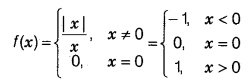
Signum function: The real function f : R → R defined
by f(x) = |x|x, x ≠ 0 and 0, if x = 0
or
Relations and Functions Class 11 Notes Maths Chapter 2

is called the signum function.
Domain of f = R; Range of f = {-1, 0, 1}


Greatest integer function: The real function f : R → R defined by f (x) = {x}, x ∈ R assumes that the values of the greatest integer less than or equal to x, is called the greatest integer function.
Domain of f = R; Range of f = Integer

Fractional part function: The real function f : R → R defined by f(x) = {x}, x ∈ R is called the fractional part function.
f(x) = {x} = x – [x] for all x ∈R
Domain of f = R; Range of f = [0, 1)

Algebra of Real Functions
Addition of two real functions: Let f : X → R and g : X → R be any two real functions, where X ∈ R. Then, we define (f + g) : X → R by
{f + g) (x) = f(x) + g(x), for all x ∈ X.

Subtraction of a real function from another: Let f : X → R and g : X → R be any two real functions, where X ⊆ R. Then, we define (f – g) : X → R by (f – g) (x) = f (x) – g(x), for all x ∈ X.

Multiplication by a scalar: Let f : X → R be a real function and K be any scalar belonging to R. Then, the product of Kf is function from X to R defined by (Kf)(x) = Kf(x) for all x ∈ X.

Multiplication of two real functions: Let f : X → R and g : X → R be any two real functions, where X ⊆ R. Then, product of these two functions i.e. f.g : X → R is defined by (fg) x = f(x) . g(x) ∀ x ∈ X.

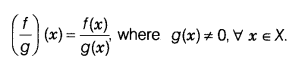
Quotient of two real functions: Let f and g be two real functions defined from X → R. The quotient of f by g denoted by fg is a function defined from X → R as
Relations and Functions Class 11 Notes Maths Chapter 2

Tuesday, February 8, 2022

Relations Class XI - RD Sharma Solved Problems

Cartesian Product of Sets

Suppose there are two non-empty sets A and B. So, the cartesian product of A and B is the set of all ordered pairs of elements from A and B.

A × B = {(a,b) : a ∊ A, b ∊ B}

Let A = {a1, a2, a3, a4} and B = {b1, b2}

Then, The cartesian product of A and B will be;

A × B = {(a1, b1), (a2, b1), (a3, b1), (a4, b1), (a1, b2), (a2, b2), (a3, b2), (a4, b2)}

Example: Let us say, X = {a,b,c} and Y = { 1,2,3}

Therefore, X × Y = {(a, 1), (a, 2), (a, 3), (b, 1), (b, 2), (b, 3), (c, 1), (c, 2), (c, 3)}.

This set has 9 ordered pairs. We can also represent it as in a tabular form.

Note: Two ordered pair X and Y are equal, if and only if the corresponding first elements and second elements are equal.

Relations

Definition: A relation R is the subset of the cartesian product of X x Y, where X and Y are two non-empty elements. It is derived by stating the relationship between the first element and second element of the ordered pair of X × Y. The set of all primary elements of the ordered pairs is called a domain of R and the set of all second elements of the ordered pairs is called a range of R.

For two sets X = {a, b, c} and Y = {apple, ball, cat}, the cartesian product have 9 ordered pairs, which can be written as;

X × Y = {(a, apple), (a, ball), (a, cat), (b, apple), (b, ball), (b, cat), (c, apple), (c, ball), (c, cat)}

With this we can obtain a subset of X x Y by introducing a relation R, between the elements of X and Y as;

R = {(a,b) : a is the first letter of word b, a ∊ X, b ∊ Y}

Therefore, the relation between X and Y can be represented as;

R = {(a,apple),(b,ball),(c,cat)}

Example: Let X={a,b} and Y = {c,d}. Find the number of relations from X to Y.

Solution: X × Y = {(a,c),(a,d),(b,c),(b,d)}

Number of subsets, n (X × Y) = 2. Therefore, the number of relations from X to Y is 24.

Solved Problems from the book of RD Sharma - Class XI CBSE

Tuesday, January 18, 2022

Mathematics Project Class XI - West Bengal Board

 Preparation of Project Work- Mathematics -XI Science

Final Date of Submission 30th January 2023( No other submission date will be provided)

Each student has to select one topic from Group-A and one topic from Group-BTwo separate files (to be collected from school) must be made. (one for each group)

The cover page must clearly contain the following information:

NAME OF SCHOOL

STUDENT'S NAME, 

CLASS-XI, SECTION & ROLL NUMBER

SUBJECT

TOPIC 

GROUP A or B

REGISTRATION NUMBER

The same information must also be registered on the first page of your copy.

Topic Group-A ( Choose any one of the following)


                 Topic Group-B ( Choose any one of the following)


IMPORTANT INSTRUCTIONS:


        I. Don't print and paste images, tables or graphs from the internet. If any graph or sketch is needed, you must prepare it on your own using graph paper & pencil.

        II. Give proper examples and diagrams as needed.

        III. USE SEPARATE COPIES FOR DIFFERENT GROUP.

        IV. USE COPIES PROVIDED BY THE SCHOOL. 

        V.  Write on one side of the paper.

Project Writing: 

Use the following structure to complete your project:

Cover Page: All details as described earlier.
First Page: Same details as on cover page.


Then divide your work in the following sections:
            1. INTRODUCTION
            2. DESCRIPTION
            3. CONCLUSION
           4. BIBLIOGRAPHY
Give appropriate graphs/diagrams and examples whenever necessary. 

Marks Distribution: (20 Marks)

        Presentation: 4 (Group-A) + 4 (Group-B)
        Note Book: 4 (Group-A) + 4 (Group-B)
        Viva-Voce: 4